The ecosystem: parts and interfaces
Each part of the end-state ecosystem, what it does, what it takes in and what it hands on. The home page shows the same parts as cards.
1The whole map
One diagram shows every part and the flows between them.
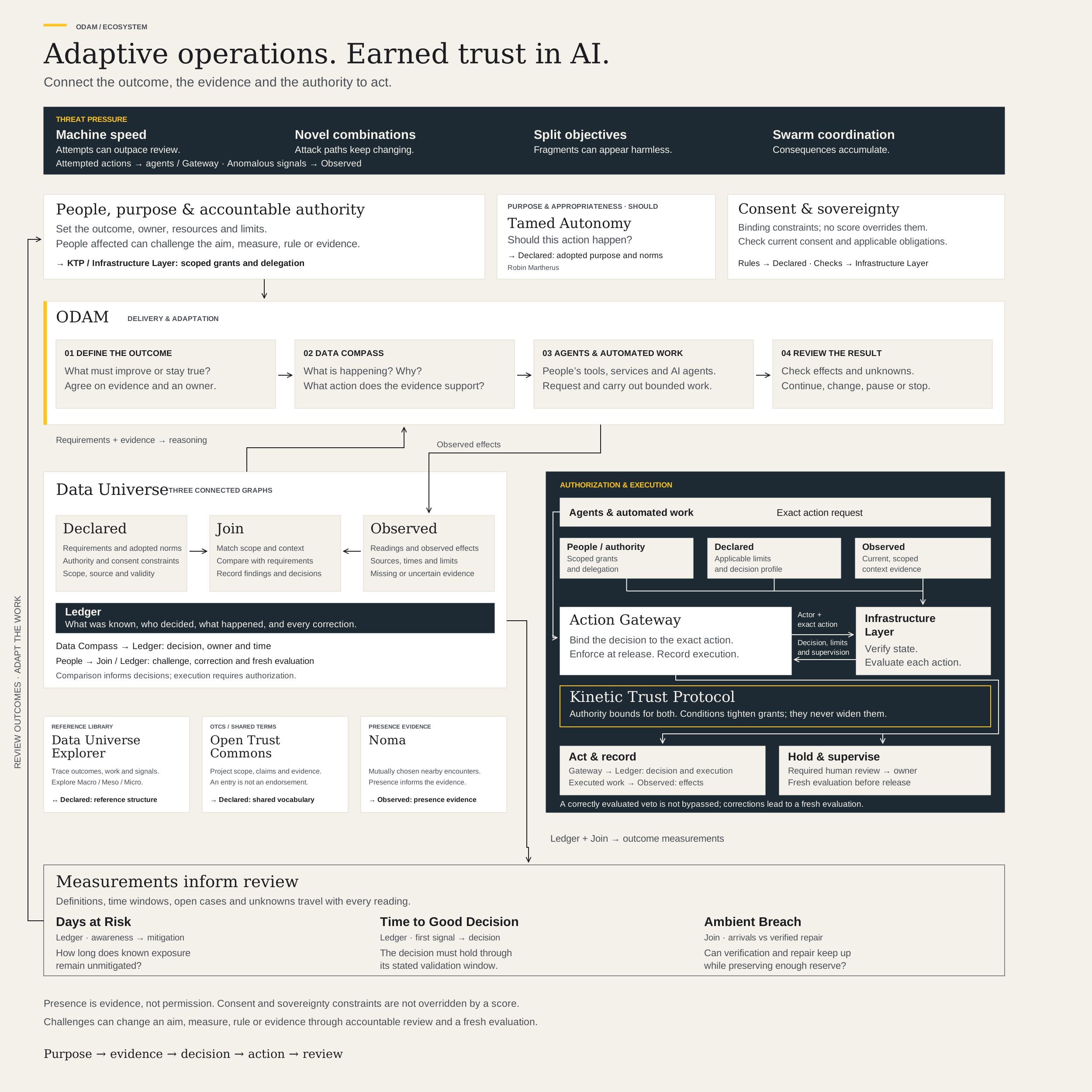
2Parts, inputs and outputs
| Part | What it does | Takes in | Hands on |
|---|---|---|---|
| Open-ended attacks against finite rulesThreat pressure | Attack paths keep changing, harmful objectives arrive in harmless-looking fragments, and consequences accumulate across agents. Finite rules and capacity have to address context, composition and cumulative effects. |
|
|
| People, purpose and accountable authorityPurpose | One outcome for the people served. Someone accountable grants and scopes authority. The people affected can challenge the aim, measure, rule or evidence. |
|
|
| Consent and sovereigntyBinding constraints | Consent, jurisdiction and data sovereignty are checked, never weighed. |
|
|
| Tamed AutonomyAppropriateness · should | A normative judgment made before anyone asks whether an action may proceed. Norms bind once an accountable party adopts them. Contributed by Robin Martherus. |
|
|
| ODAMDelivery and adaptation | The delivery loop. People's tools, services and AI agents request and carry out bounded work; the team reviews effects and unknowns and decides to continue, change, pause or stop. |
|
|
| Declared → Join ← ObservedData Universe · three connected graphs | Declared holds commitments, requirements, roles, scope, authority and the decision profile. Observed holds readings and events with sources, times and limits, including what's missing. Join matches scope and context, compares, and records findings and decisions. Comparison grants no authority by itself. |
|
|
| Data CompassDecision reasoning | The reasoning practice inside the loop: connect observations, explanations and unknowns to the action the evidence supports. |
|
|
| LedgerHistory · the record of every decision | What was known, who decided, what happened, and every correction. Records keep their source, scope and history; corrections are added, never written over. |
|
|
| Days at RiskMeasure | A plain count from the earliest record that shows you knew, never shortened by a slow acknowledgment. |
|
|
| Time to Good DecisionMeasure | The decision must hold through its stated window. Measured per incident class at the 90th percentile, with reversed and open cases shown beside it. |
|
|
| Ambient BreachMeasure | Compares the arrival of uncertainty with verified repair. A flat backlog doesn't prove the reserve is safe. |
|
|
| Action GatewayExecution | Binds the decision to the exact action, sends the actor and action to the Infrastructure Layer for evaluation, enforces the result at release, and records the execution. After a required human review, a fresh evaluation runs before release. |
|
|
| Infrastructure LayerInfrastructure | Evaluates each action and answers the gateway through its own interface. |
|
|
| Kinetic Trust ProtocolAuthorization | Authority is evaluated at the moment of the act, from the grant, the exact action and the current context, not only from a credential issued earlier. A correctly evaluated veto is not bypassed; corrections lead to a fresh evaluation. |
|
|
| Data Universe ExplorerReference view | Trace outcomes, work, roles and signals across Macro, Meso and Micro. |
|
|
| Open Trust CommonsCoordination and registry | Projects describe what they claim and what supports it, in one vocabulary, so they can be compared. An entry is not an endorsement. |
|
|
| NomaPresence evidence | Presence informs the evidence. Presence is evidence, not permission. |
|
|
3Rules that hold across the map
- Comparison grants no authority. A finding in Join informs a decision; it doesn't authorize the action.
- Conditions tighten granted authority; they never widen it.
- Consent, jurisdiction and data sovereignty are checked, never weighed against a score.
- Presence is evidence, not permission.
- A registry entry is not an endorsement.
- Records are corrected by adding to them, never by writing over them.
- The people affected can challenge the aim, the measure, the rule or the evidence.